Sunday, November 4, 2012

3-Point Plan for Sustainable Eating IV

I have come a long way with most of my personal project, while a third of it has completely stagnated. My efforts will continue, but it is clear which parts of the project are really taking shape. In the next few weeks, I will attempt to concentrate more on those aspects that are underdeveloped. Nonetheless, I am ecstatic that at least part of my personal project has come together.

Composting


Composting has been the greatest success by far, which I am particularly proud of. I have attempted composts piles in the past that never reached their full potential because I gave up on them. Thankfully, this personal project gave me a good reason to stick with it. As you can see in the pictures below, my compost has formed a fairly fertile soil. It has some more decomposing to go, but I think in the next month or so it should be pretty rich. My main concern is what I will do with it in the winter. Hopefully I can place it under the stairs outside of my apartment complex. I definitely will not stop after this much success.


Cleaning the transfer compost bin is always the worst part, but I use the water to wet some of my outside compost pile. Composting triumphs the garbage again!

Now that my compost is turning into a decent soil, it is time to research the best ways to use it in my future garden. Here is a pretty informative video that discusses the art of incorporating compost into your garden. Techniques include side dressing, broadcasting, dumping and spreading. You can also use a pitchfork to spread the compost for aeration purposes. Even though it seems rather straight forward, its better to make sure that you are doing it right.


Rain Barrel

On a different note, this is the third of my project that I am most disappointed with. Not much to report here except that I have made a few additional calls to businesses. I have called the major grocery stores such as Marsh, Kroger, and O’malia’s, but every person I talk to says they do not use gallon-plastic barrels. From the few car washes I have called I have not received an answer, but I may need to call at different hours. So the search for the barrel continues! I refuse to buy one because there are countless videos online with folks talking about how they got their barrels for free. I know I can do this, it’s only a matter of talking to the right person at the right time.

Plant-Based Meals


My plant-based meals continue, though they are not as substantial as I would like them to be. I continue to roast peppers and make spinach salads, and when I’m lazy I eat an apple or two. Tomorrow or Tuesday I plan on making these falafels, which I have made before. And look I already have the garbanzos beans!


Economic Democracy: The Credit Union as an Asset of Community Economic Development

For quite some time I have been interested in credit unions as an alternative to commercial banks. I have been, however, a lifetime customer of J.P. Morgan Chase Bank simply because my father worked for Chase and I never really understood the rationale of a credit union. While I was growing up the only credit union I remember seeing was the Indiana Members Credit Union located on East 82nd Street, but I did not pay it much attention. Similar to other community based and sustainability practices, I did not engage in them because they were not the norm and no one had informed me of their benefits.

As a sophomore undergraduate at Indiana University, I somehow decided to major in nonprofit management at the School of Public and Environmental Affairs. In my first nonprofit course, V221 The Nonprofit and Voluntary Sector, taught by Rebecca Nannery, we discussed the different types of IRS tax-exempt organizations. To my surprise, credit unions were in fact tax-exempt, just like public charities and political advocacy groups. According to the IRS, Federal Credit Unions, corporations organized under act of congress, are 501(c)(1) organizations, while state-chartered credit unions are 501(c)(14) organizations. Both types of credit unions are tax-exempt, meaning they are generally not subjected to state sales, payroll, property, federal income, and other taxes.

Although I did not learn anymore about credit unions in my other nonprofit classes, my interest and respect for the nonprofit sector intensified. This respect combined with my father ending his career with Chase after 25 years, my seasoned political views, and the 2008 financial crisis has driven me to the point where I feel obligated to transfer what little money I have in savings to a credit union. If I had made this decision earlier in my college career I probably would have given the IU Credit Union a try; however, it is not too late to use it as a resource to finding out more about making the change.

Since Roseland emphasizes the use of local credit unions as an important tool for promoting community economic development, it seemed appropriate to highlight some key features of these financial institutions and why they are important. Roseland declares that “[community economic] development without growth can be encouraged by supporting existing businesses and increasing the number of times each dollar circulates within the community” (214). Considering that major commercial banks—J.P. Morgan Chase, Bank of America, Wells Fargo—extract capital from communities in form of deposits, its understandable that state and other local credit unions are more likely to increase local economic development by keeping more money in the community. Due to the tax-exempt status of credit unions, these institutions do not distribute profits to shareholders, as do commercial banks. Like all other nonprofits, when a credit union makes any type of profit the money is reinvested in its operations, resulting in lower loan interest rates, higher interest on deposits, and little to no service fees.

It is widely understood that to be a part of a credit union a person must become a member. Membership is usually based on a shared connection such as profession or a geographic region. Fortunately for those who are not teachers or firefighters, you are able to become a member of your city or town credit union if you have decent credit history. As a result, you will own a portion of the union through a mutual trust bond with other members. Credit unions have therefore been described as economic democracies, meaning that each member has equal ownership and therefore a say in how the voluntary board operates the union. According to the United States Census Bureau, there were approximately 500,000 federal credit union members and 40,000 state credit union members in 2010. The number of members in each type of union has risen dramatically since 1990.

These two informational videos go into further detail about the benefits of being a credit union member:

My favorite part of this video is when Ms. Gibbons says that credit unions were not caught up in the 2008 subprime mortgage fiasco, thus credit union loan portfolios are now increasing rather than declining. I find it baffling that she says that 90 million citizens are credit union members—a number that conflicts with that of the U.S. census.

Mr. Lee makes me happy to hear that if I do not like the way my credit union is being operated then I am able to vote for new board members or even run as a board candidate. This gives me a feeling a great control over my deposits and how they are being used. I also appreciate how he outlines the importance of credit union customer service. He discusses how this can build healthy relationships, contributing to the social capital that Roseland stresses as a key component of effective community economic development.

Are any of you credit union members? Are they all they are cracked up to be? The only downside I can think of is that credit union ATMs are not widespread, making it difficult to avoid service charges from commercial bank ATMs when you are in another city.


Roseland states that most contemporary “community economic development initiatives focus on augmenting individual and community self-reliance through collaborative action, capacity-building and returning control of business enterprises, capital, labor and other resources from the global market to communities” (216). If that is the case, credit unions meet all three points of Roseland’s concept of community economic development. In the truest sense, credit unions epitomize local self-reliance and financial security. If you are considering switching banks anytime soon, it may be a good idea to find your local credit union and live more sustainably.

Monday, October 15, 2012

The Power of Traffic Calming

Automobile traffic dominates the built environment of our urban cities. It not only rules the road by means of infrastructure, but also with the weight and velocity of its many parts. With the infrastructure green light (pun!) and the freedom to careen at unmatchable speeds, the United States road is discriminating and an overall attack on non-motorize accessibility. Some may argue that the roads are made for cars, thus you do not witness the automobile infiltrating sidewalks or bike lanes. It is true that the road was primarily designed for the car, though carbon-neutral and more vulnerable modes must safely access them as well. The path of the automobile is pervasive and crosscutting, marginalizing all other forms of transportation such as walking, wheeling, and biking.

Traffic calming, which is “the process of slowing down traffic so that street environment is safer and more conducive to pedestrians, cyclists, shoppers, and residential life,” is mostly implemented through physical alteration of roadways (Newman and Kenworthy, as cited in Wheeler and Beatley). The notion of traffic calming is inherently at odds with many daily commuters. These calming measures can add to congestion and travel time for motorists. Although the measures seem like an attack on the personal automobile and other motorized vehicles, they are simply making the streets safer and more appropriate for non-motorists. This leveling of the playing field may further inconvenience for drivers, but it certainly enables the convenience of other modes.

In the name of accessibility, here are some of the ways that transportation planners are developing strategic designs to calm the incessant buzz of traffic in our communities:


Textured Pavement

Source: Construction Photography


Chicane (or S-Shaped Diverter)

Source: Richard Drdul, Flickr


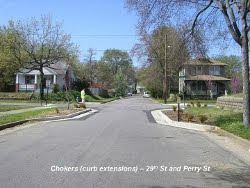
Neck-Down (or Choker)

Source City of Richmond


Speed Bump (or Speed Hump)

Source: City of Lynnwood


Bulb-Out

Source: Calm Streets Boston


Other traffic calming tools and methods include adding bike lanes, narrowing the number of street lanes, and simple landscaping designs (e.g., planting trees on roadsides). The following video further describes common traffic calming measures:


According to Newman and Kenworthy, slowing traffic with the use of traffic calming mechanisms has many benefits: reduction in traffic accidents, better air quality, less noise pollution, increased sense of community, and decrease crime rates.

Unfortunately, traffic calming measures are not flawless. There are also a number of disadvantages associated with these structures. Traffic congestion and public outcry can result if the municipal governments that implement the measures do not effectively socially market the new barriers. Unaware drivers are likely to make illegal moves and endanger the lives pedestrians and cyclists (e.g., veering into bike lanes). The demand for personal automobile use will rise during the winter season and regular adverse conditions, and traffic calming measures can catalyze congestion. Also if the calming measures are not widely implemented traffic will simply be diverted to other roadways. Lastly, as discussed in class, emergency vehicles can be delayed due to measures such as speed bumps, endangering public safety. The following video touches upon that point:


Personally, I am a big fan of traffic calming. It makes drivers more aware and allows them to operate their vehicles at a safe speed. I do not believe, however, that traffic calming is a sole solution to accessibility. Traffic calming should be couple with other transportation measures such as 4-6 ft. wide sidewalks and efficient public transit.

In my neighborhood in Indianapolis, there was a controversial traffic calming scheme put into place on 62nd Street, a four-lane roadway going in and out of Broad Ripple Village. For those of you unfamiliar with Indianapolis, Broad Ripple Village is an area akin to Kirkwood Avenue, a cultural hub lined with bars, boutiques, and restaurants. Members of the public approached The Indianapolis Office of Sustainability to scale 62nd Street from a four-lane street to a two-lane street with the addition of two bike lanes, one on each side of the street. After months of construction, the street was narrowed and the bike lanes were complete. What you think would have been a celebratory moment for my neighborhood turned into communal backlash. According to Kristen Trovillion of The Office of Sustainability, the Department of Public Works received frequent complaints for weeks. Traffic was backed up for blocks. Drivers did not understand how to navigate the road without veering into the bike lanes. It was a mess. Eventually, the area learned to live with the lanes, but not without a struggle.

It is funny how sustainability measures can sound great on paper, but when implemented in communities, neighbors tend to backlash at the reality of the change. The reality is that the future of sustainability holds a world of sacrifice, and our readiness and willpower to change our habits is very important.

Thursday, October 11, 2012

3-Point Plan for Sustainable Eating III

The third installation of my project update finds me patiently observing the effects of my compost, grappling with my self-imposed rain barrel budget, and sticking to the basics with my plant-based meals. Even though my personal project has momentarily taken the backseat to preparing for midterms, I continue to contribute a little time each week to making some progress.

Composting

My pile is at risk of being oversaturated with coffee grounds, filters, and tea bags. Those green materials have been stacking up rather quickly (mostly attributed to my studies), therefore autumn has arrived at the perfect time. I am in need of more brown materials to layer onto the pile. Composting has made me reflect much on how much food I eat and waste. As hard as I try, I have not been able to keep up with my spinach leaves and other green veggies. Many of them spoil before I can make a dent in my fridge stock. Though it is good for my compost pile, I have to reevaluate how much I buy at the grocery store or how much of my meals are incorporating fresh vegetables. I have an inkling I’m not very creative at incorporating vegetables into my lunches and dinners, and I cannot think outside the box (the frozen, process food box, that is). That leads me to my plant-based meals, which I will discuss shortly.

Here are the two very informative compost sources I have been using:

• Composting 101

• Home Composting Made Easy

Both lend helpful hints on how to get the most out of your pile. I consult them both when I am weary about my carbon to nitrogen ratio. For my first stab at it, I think I am doing okay, mixing the pile a couple times a week. In the future, it would be great to really pay attention to layers and incorporate worms.

Here are some photos of my progress (riveting, right?):


Rain Barrel

Oh rain barrel, how I wish to acquire you. My $20 budget was intended to be a challenge, and it has succeeded in doing so. Since I refuse to use PVC pipes, I have to resort to the more expensive metal tubing materials. The more robust materials and sealant are pricey, but I am optimistic that it can still be done! When I have asked around at the larger supermarkets for any extra or unused food barrels, they are either confused or do not have any. I have only reached out in passing, but intend to phone other types of establishments in the near future. I have a feeling that I’ll get luckily with some of the car washes around town. My $20 budget will not suffice without obtaining a barrel for no cost. To be continued…

Plant-Based Meals

Although this part of the project was aimed at cooking up some delicious cuisines, my time constrained diet and laziness have gotten the best of me. Lately, I have relied mainly on spinach salads (though I still can’t get through the entire bag before it goes bad, does this happen to any of you?) and bell peppers with hummus. No the hummus is not homemade! But I intend to improve this part of my project. Cereal for dinner must cease. Tonight I plan to prepare Fennel Mushrooms.
The recipe appeared on my Gmail ticker earlier this week and I have been thinking about it ever since. I will be sure to let you know how it tastes!

Monday, September 24, 2012

Lesser of Two Evils: Indianapolis Waste Incineration


Unless you pay for the services of The South Side Landfill,
the Harding Street Incinerator
is the only option for municipal solid waste removal for the city of Indianapolis. Also known as The Indianapolis Resource Recovery Facility, the incinerator is managed by Covanta Indianapolis, Inc. As one of the largest incinerators in the nation, the facility processes 2,175 tons of solid waste per day, which in turn produces 4,500 pounds of steam. Citizens Thermal Energy (CTE) purchases around 70 percent of the steam to power 40 percent of the downtown heating loop. The heating loop is made up of almost all of downtown Indy’s businesses and institutions, including IUPUI and Eli Lilly (Covanta Energy 2012).

It is understandable that Indianapolis-Marion County would support this form of waste management given its win-win, short-term benefits of ridding almost all citywide waste and ostensibly powering its urban center with “renewable energy.” Unfortunately, that steam energy is not renewable in the traditional sense. It might lessen the city’s dependence on fossil fuels to provide electricity to the downtown area, though incineration is accompanied by its own set of harmful emissions: carbon monoxide, sulfur and nitrogen dioxides, dioxin, and metal. Its operations even produce CO2 emissions. The copious amounts of ash residue that is produced by these facilities still end up in landfills. Incineration or the euphemized “recovery” of energy is a seemingly better choice than completely fostering landfills, but it is evil (to sustainability) nonetheless.

Indianapolis currently does not have a sustainable countywide waste management system for municipal solid waste. Residents who opt out of composting at home throw food scraps and other biodegradable matter into the garbage and is burned on the side of State Road 37. While the Office of Sustainability
only promotes non-mandated curbside recycling
and periodic toxic product drop-off services
and the Indiana Department of Environmental Management (IDEM)
lawfully prohibits throwing away yard waste, there is no municipal or state effort to promote the broader possibilities of composting.

Considering that waste management is largely a municipal function, could it be that a publicly sponsored composting effort would counter the interests of Covanta Indianapolis, Inc. and the entire downtown region? Or is the city just behind the times of sustainable waste management? It is likely that the city could fall under both categories given that general recycling is not publicly mandated. If Indianapolis-Marion County adopted a policy similar to Bloomington’s recycling ordinance
or Ann Arbor’s compost curbside pickup,
it would likely lessen the amount of waste needed to produce adequate electricity for downtown.

The video below gives a snapshot of how the facility operates and the supposed benefits of trash incineration:

Indianapolis is missing out on an opportunity to better the city’s air and natural environment by implementing some of the recycling and composting regulatory tools outlined by Roseland. Many European cities that previously depended on incinerators to manage waste have chose to instead invest in new recycling and composting facilities. Perhaps Indianapolis might someday find a window of opportunity to close the expensive incinerator and rather provide city sponsored curbside recycling and composting? Recycling has been proved to be three to six times more energy efficient than incineration (Girardet 1999). Composting makes use of what many regard as waste. Both of these efforts can narrow the cycle of production and consumption. The questions are whether the city is willing to make the decision, and whether an alliance of citizens is willing to demand it.


Lyle, John T. (1994). Waste as a Resource. Regenerative Design for Sustainable Development.

Girardet, Herbert. (1999). The Metabolism of Cities. Creating Sustainable Cities.

http://www.covantaenergy.com/facilities/facility-by-location/indianapolis/about.aspx

Saturday, September 22, 2012

3-Point Plan for Sustainable Eating II

My sustainable eating voyage continues, slowly, but surely. I have made significant progress with composting and cooking plant-based meals. The rain barrel effort will see more action once I catch up with my other studies. Composting is the more passive and eating is inevitable, therefore in the following weeks you will see more updates concerning those aspects of the project.

Composting

Smelly compost. Emptying and cleaning the smaller container in my studio apartment sink has taken a toll on my nasal cavity, but that is my only complaint. Actually, I have so few fruit flies in my apartment because I keep my food scraps in the smaller airtight container. Today was the first day that I transferred those food scraps to the larger compost bin. I wrote “Compost: Do Not Move” on the top of the container and tucked it away in an inconspicuous location on the side of my building. Luckily, the stench will remain outside. The food scraps were mixed in with some moist dead leaves that will, hopefully, make for a rich soil when things begin to decompose.

Rain Barrel

The search for the rain barrel supplies continues, though I have not been actively searching. Since I am trying to build one without spending more than $20.00, I have started a list of local restaurants, grocery stores, and even carwashes that might have a bin that they are willing to let go. It will take some calling around town to find a sympathetic donor, but I am optimistic. I will begin calling next week. In the meantime, I have been watching instructional videos online. There are many but I will probably borrow ideas from the best of the bunch. The video below, for instance, is sponsored by Lowes and provides helpful suggestions. I refuse to use PVC pipe materials because of the harmful effects from the chemicals in the material. Does anyone know of any alternatives that are relatively inexpensive? I may resort to traditional metal pipes and materials.

Cooking Plant-Based Meals

Last week I made these Portobello and Zucchini Tacos
.My girlfriend introduced me to them and I have since made them twice. Although my food will not always be 100 percent locally grown and will include some packaging, I will try my best to use unpackaged fruits and veggies from BloomingFoods and the Farmers Market. I will resist the temptation to indulge at the larger supermarkets such as Kroger. My search continues for delicious recipes. Any suggestions?

Friday, September 21, 2012

Locals Only: Big Red Eats Green

It has been two weeks since I made my way over to the Indiana University Art Museum to grab some local chow at the Big Red Eats Green (and Bikes) Festival. My weekend starts on Thursday so I was looking forward to kicking it off right. As I approached the art museum lawn from the Union, I saw the many tents and booths and my stomach began to growl. The time was 2:15pm and I had not eaten breakfast. After briefly chatting with some fellow SPEONS at the entrance, I managed to stroll through the fair, peeking in the restaurant booths. I couldn’t believe that all participating restaurants used local ingredients. I have my doubts that the entire dishes were composed of Indiana ingredients, but the point is that they incorporated local food into their dishes, supporting local growers, and contributing to food security.

I thought it might be a good idea to first check out a familiar restaurant. It seemed appropriate to check out the Upland Brewery tent since love the food, but rarely eat there. I was willing to spend around $6.00 so that limited me to about 2-3 items. The Caprese Sandwich seemed like an excellent choice since it was only $1 and included roasted tomato focaccia, basil, and mozzarella cheese. It was delicious, though I was a little bummed they didn’t bring any beer growlers to sample!

As I turned to leave the Upland Booth, a gentleman with a piece of yarn in his hand accosted me. He asked, “Have you gotten one of these?” as he gave me a blue bracelet that displayed the words “I Ate Local.” I did indeed eat local, and I was now looking for the next restaurant to taste. I wanted to go to a place that I had never been before, but noticed Feast was selling their signature tamales for only $3.00. I’m a man that refuses to pass up a bargain so I seized the moment with great joy.

After delving into the delightful staples of Bloomington, it was time to try something new. I turned to the booths near the entrance, and to my surprise, Restaurant Tallent had made an appearance. I have never been to Restaurant Tallent given its reputation for its expensive entrees. I chatted with a fellow SPEA student while the gentlemen behind the table prepared a BBQ squash sandwich. The sandwich was superb and I washed it down with some iced cold watermelon limeade. When I finished I place my plastic dish and silverware in the available recycling bins. It will be a great day when recycling and compost bins out number trashcans.

Although I wanted to try samples from all of the other restaurants, I had exhausted my budget. It was time to check out what else the festival had to offer. I talked with the owner of Traderspoint Creamery about its award-winning yogurts. I sampled some low-fat vanilla. Historically, I have never been the biggest yogurt enthusiast, but it was so good I will buy some at one of its participating locations. Both the Sprouts and IU Campus gardens looked like great opportunities to grow my own food in the spring. The festival also introduced me to the Dunn Meadow CafĂ©, which I had heard about but did not realize that it too used local ingredients. In fact, I have been there twice in the past two weeks because it is relatively inexpensive and provides lighter alternatives to traditional RPS food. Plus it’s a short walk from SPEA! Overall, I really enjoyed myself Big Red Eats Green (and Bikes) Festival.

Similar to the weekly farmers market , Big Red Eats Green and other outdoor events provide an inclusive environment that bring about a sense of community. The aspects of sustainable communities that emphasize place and a sense of belonging are so important. I would like to contribute more to that feeling of community in the future through volunteering and my career.

For all interested in more local businesses,Local First Indiana is an awesome nonprofit that emphasizes local commerce and activities. Check it out!